This guide is for Hobart 4WD owners heading out on Tasmanian tracks, from short runs in the south to the remote west coast. It covers the electrical side of a touring setup: a second battery that copes with cold nights, wiring that survives mud and water, and the checks worth doing before you leave town.
Sponsored
Your auto electrical business, front and centre in Hobart
This spot is shown to people looking for auto electrical help anywhere in Hobart. See sponsor spots and prices.
How can we help?
Need it fixed?
Get a quote from a local 4WD and Dual Battery Setups for Tasmanian Trips from Hobart auto electrician, for anything from a flat battery to a full fit-out.
Get a quoteBuying parts?
Quality auto electrical parts from Ozautoelectrics, an established Australian supplier since 2010, dispatched through a nationwide network. For retail and trade buyers.
Shop partsDoing it yourself?
Free step-by-step guides written for Tasmania conditions, with the parts you’ll need listed for each job.
Browse DIY guidesAuto electrician in 4WD and Dual Battery Setups for Tasmanian Trips from Hobart?
Are you an auto electrical business? List your business on this site.
List your business on this siteTasmanian tracks from a Hobart base
Some good 4WD country sits close to Hobart. The East West Trail in Wellington Park runs about 20 km from Montrose over the Wellington Range to Crabtree in the Huon Valley. It's rated difficult, with deep bogs, steep slopes and alpine weather, and it's permit only. At the time of writing, Parks and Wildlife Service Tasmania listed it as closed for the season from January 2026 while access over a private section is sorted out, so check before you plan around it.
Further south, the Southport Lagoon track is a slow, rocky drive of about an hour. Across the D'Entrecasteaux Channel, the Bruny Island ferry leaves from Kettering, and Cloudy Bay beach is signed for vehicles only at low tide, on the wet sand, to reach the campground or launch boats. Tasmania Police has warned drivers about dangerous driving there.
The bigger trips are a long day's drive away. The Sandy Cape and Balfour tracks in the Arthur-Pieman Conservation Area on the north-west coast need an Arthur-Pieman Recreational Driver Pass, and tracks inside national parks, such as the Mount McCall Track, need a National Parks Pass for the vehicle. Vehicles must be registered and drivers licensed, even off the bitumen.
What Tasmania asks of your 12V system
Mainland 4WD electrical advice is often written for heat and dust. In Tasmania, the bigger tests are cold nights, wet weather and short days. A fridge works less hard in the cold, but lights, heaters, phone and radio charging run for longer when it's dark by late afternoon. Overcast weeks also mean a portable solar panel may only cover part of your daily use, so most of your charging will come from driving.
Overnight temperatures can drop well below freezing in the highlands. The Bureau of Meteorology recorded a provisional Tasmanian record low of -14.2 degrees at Liawenee on the Central Plateau in August 2020. You won't camp in those conditions often, but frost at camp is normal for much of the year inland.
Advertisement
Picking a second battery for the cold
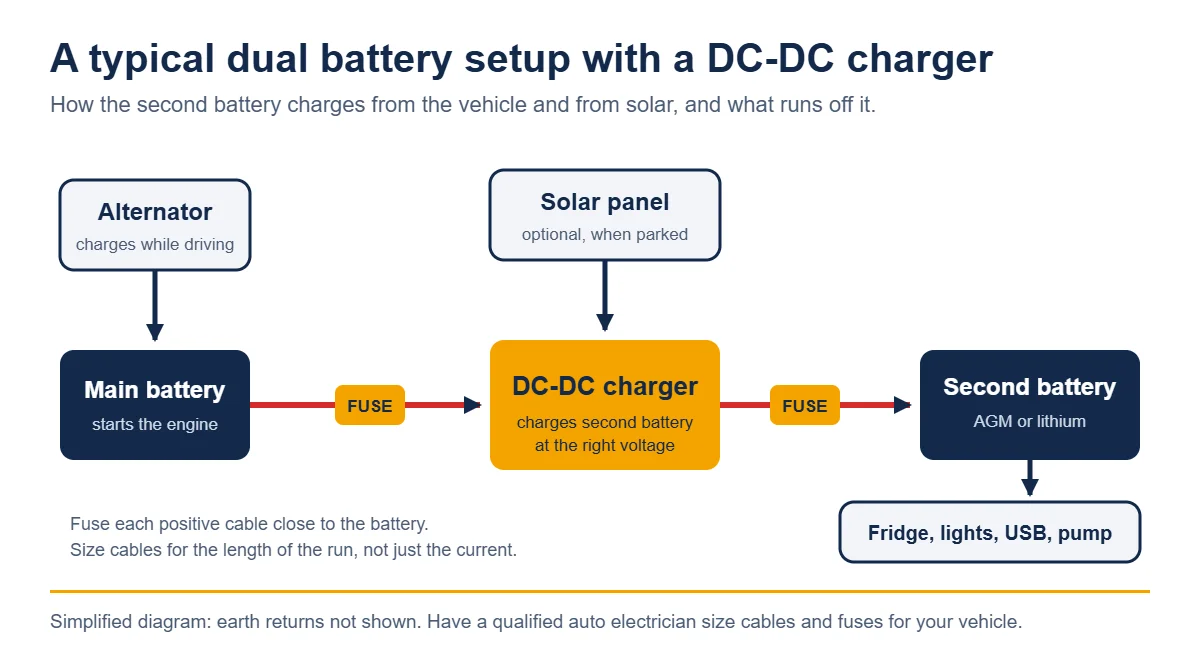
A dual battery setup keeps your starting battery for starting and runs your camp gear from a second battery. Our guide on how a dual battery system works covers the layout.
Battery choice matters more in the cold. Lithium batteries are light and hold their voltage well under load, but many are built to stop accepting charge at or near freezing to protect the cells. Some include a low-temperature heater or charge protection, and some don't. If yours is in an unheated canopy or under-tray box, read its cold charging limits before a winter trip. AGM batteries charge more slowly but generally accept charge in cold weather. Our car battery types explained guide compares them.
Whichever you choose, charge it with a DC-DC charger if your vehicle has a smart alternator, because a simple isolator may leave the second battery short. See DC-DC charger or isolator to work out what suits your vehicle and battery.
Mud, buttongrass and river crossings
Tasmanian tracks are often wet rather than dusty. Bogs, buttongrass plains and creek crossings throw mud and water at everything under the vehicle. Water that gets into a connector doesn't just cause a fault on the day. It sits there and corrodes the pins over the following weeks, so a fault can show up long after the trip.
Mount the DC-DC charger, fuses and circuit breakers high and away from spray. Use sealed connectors and plugs with weatherproof caps for anything outside the cabin. A light coat of dielectric grease on plug pins helps keep moisture out. Parks and Wildlife Service asks drivers to cross rivers only at designated points, so know where they are and what your vehicle can handle before you go. After a wet trip, check for water inside light housings and around your auxiliary fuse block.
Wiring that survives rocky tracks
Slow, rocky tracks are hard on wiring too. Sharp jolts crack poorly supported plugs, flex cables at the terminals and loosen battery hold-downs. Use a battery box or tray made for your battery size, with a solid clamp. Support cables with proper clips so they can't move at the lugs, and run them through grommets wherever they pass through metal.
Fuse every cable that's connected to a battery, as close to the battery as practical, and at both ends on long runs between batteries. Size the cable for the full length of the circuit so you don't lose charge to voltage drop. Our guide on what size cable you need for 12V shows how. If you use Anderson plugs for a fridge or solar panel, crimp them properly and keep the dust caps on in wet weather.
Radios, lights and keeping in touch
Phone coverage drops out quickly on many Tasmanian tracks. Parks and Wildlife Service recommends carrying a UHF radio on the East West Trail and travelling with at least one other vehicle. A fixed UHF wired to the auxiliary battery keeps working when you're stopped with the engine off. Tell someone your plans and when you expect to be back.
Short days mean you may find yourself driving out in the dark. Extra driving lights or a light bar must meet Tasmanian rules on number, mounting and switching, so read the Department of State Growth's vehicle information bulletins before you fit them. Camp lights should run from the auxiliary battery, never the starting battery.
Clean before you go
Parks and Wildlife Service asks drivers to clean vehicles thoroughly before entering reserves, to stop the spread of soil-borne diseases and weeds. That means washing mud from the underside, wheels and arches between trips. Be gentle around electrics when you do it. Hold the pressure washer back from plugs, the alternator, the starter motor and the DC-DC charger, and let the vehicle dry before you check anything electrical.
Checks before you leave Hobart
If you'd rather have the setup built or checked by an auto electrician, start with our Kingston page if you live south of the city, or Glenorchy if you're in the northern suburbs.
- Charge the auxiliary battery fully and run the fridge overnight at home to confirm it holds up.
- Start the engine and confirm the DC-DC charger shows it's charging.
- Check every terminal, lug, hold-down and fuse holder is tight and dry.
- Test your UHF radio, camp lights and any driving lights.
- Carry spare fuses, a few crimp lugs, electrical tape, a multimeter and a jump starter.
- Check track status, permits and passes with Parks and Wildlife Service.
Parts for this job
Order quality parts online from Ozautoelectrics, dispatched Australia-wide.
Get it done: get a quoteDo it yourself: shop DC-DC chargers
Get it done: get a quoteDo it yourself: shop deep cycle batteries
Get it done: get a quoteDo it yourself: shop Anderson plugs
Get it done: get a quoteDo it yourself: shop circuit breakers
Questions Hobart drivers ask
Do I need a permit to four-wheel drive in Tasmania?
It depends on where you go. The Sandy Cape and Balfour tracks in the Arthur-Pieman Conservation Area need a Recreational Driver Pass, tracks inside national parks need a National Parks Pass for the vehicle, and Wellington Park's East West Trail needs a permit. Some tracks need special authorisation. Check with Parks and Wildlife Service Tasmania before you go.
Will my lithium battery charge on a frosty Tasmanian night?
Maybe not. Many lithium batteries stop accepting charge at or near freezing to protect the cells, while others have built-in heaters or low-temperature charge protection. Check your battery's cold charging limits. If it's mounted in an unheated canopy or tray box, it may not charge on a cold morning until it warms up.
Is solar worth it for 4WD trips in Tasmania?
It helps, but don't rely on it alone. Short winter days and cloud cut solar output, so a panel may only cover part of your daily use. A DC-DC charger that charges the auxiliary battery while you drive does most of the work. A panel that plugs into the same charger is a good backup on longer camps.
Can I drive on Cloudy Bay beach on Bruny Island?
Tasmania Police says Cloudy Bay beach is signed for vehicles only at low tide, on the wet sand, and to reach the campground or launch boats at Cloudy Corner. Police have taken action over dangerous driving there. Check the signs and current rules when you arrive, and keep salt water away from your vehicle's wiring.
Need an auto electrician in Hobart?
Find local auto electricians and mobile services in the Hobart directory, or start with your area: Kingborough, Glenorchy, Hobart City.
Search auto electrical parts
Searches the full range at Ozautoelectrics, opening in a new tab. Popular: dual battery · LED light bars · trailer plugs · fuses
Run an auto electrical business in 4WD and Dual Battery Setups for Tasmanian Trips from Hobart?
- New to Ozautoelectrics? Apply for trade pricing on quality auto electrical parts.
- Already a trade customer? Log in and order parts at your trade price.
- Want more local customers? List your business on this site so drivers in 4WD and Dual Battery Setups for Tasmanian Trips from Hobart can find you.
Not confident doing this yourself?
There’s no shame in handing it over. A local auto electrician can diagnose the fault properly and get it done safely, especially for anything involving brakes, airbags, hybrid systems or air-con gas.
Get a quote from a local auto electrician Or shop the parts and do it yourself